Taalas HC1: Llama chip specs, speed and cost
Taalas burned Llama 3.1 8B into silicon: 17,000 tokens/sec, about $0.0075 per million tokens, LoRA adapter support, and no on-premise sale yet.
A Canadian startup called Taalas just did something that sounds impossible: they took Meta's Llama 3.1 8B model and hardwired it directly into a chip. They etched the model weights into 53 billion transistors on an 815mm² die.
The result? 17,000 tokens per second per user. That's roughly 8 to 74x faster than anything else on the market, including Nvidia's H200, Groq's LPU, and Cerebras's wafer-scale engine.
The most interesting part is that despite being hardwired, the HC1 supports LoRA fine-tuning. And that changes everything about how we should think about fine-tuning's role in the AI stack.
What Taalas Actually Built
The HC1 is an application-specific integrated circuit (ASIC) manufactured on TSMC's 6nm process. Instead of using general-purpose compute to run model weights from memory (the way every GPU does it), Taalas compiled the Llama 3.1 8B architecture directly into silicon.
The key specs:
| Specification | HC1 |
|---|---|
| Model | Llama 3.1 8B (hardwired) |
| Process | TSMC 6nm |
| Die size | 815mm² |
| Transistors | 53 billion |
| Throughput | ~17,000 tokens/sec per user |
| Power | 2.5 kW server |
| Quantization | Custom 3-bit base + 6-bit parameters |
| LoRA support | Yes (configurable adapters) |
| Context window | Configurable |
The company emerged from stealth mode in February 2026 after raising $169 million from Quiet Capital, Fidelity and semiconductor investor Pierre Lamond, which Reuters reported as bringing the total to $219 million. A 24-person team built the HC1 on roughly $30 million of actual spend, which is a striking number in a field of nine-figure chip programmes. All figures are as of February 2026.
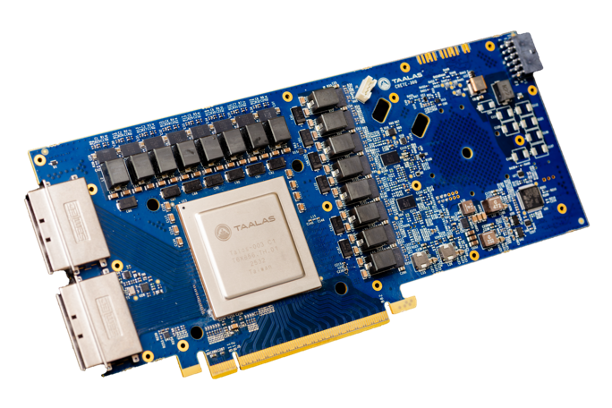 Source: Taalas. Image reproduced for editorial commentary. All rights belong to Taalas Inc.
The Performance Gap Is Staggering
The benchmark numbers put the HC1 in a different category from existing inference hardware:
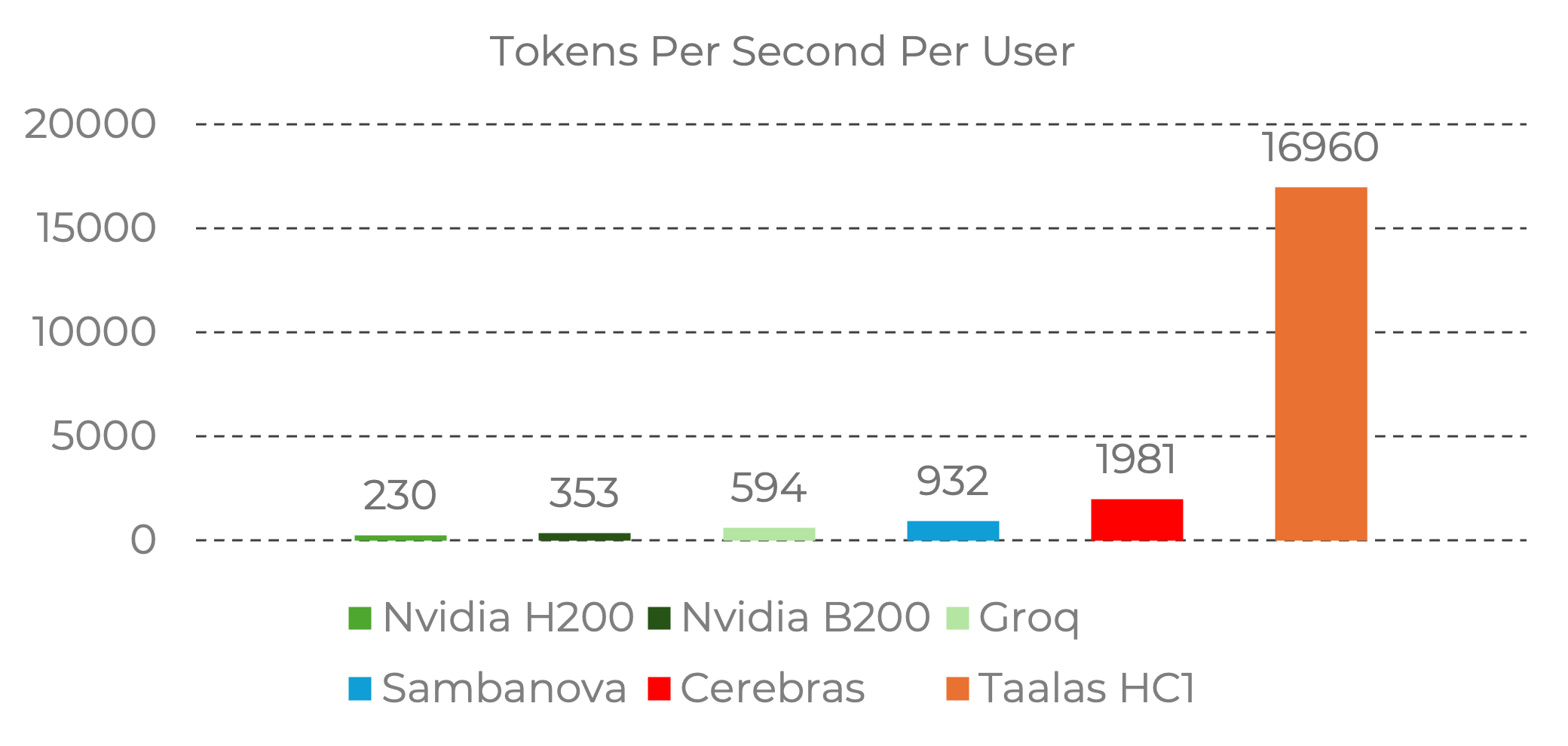 Source: Taalas. Benchmark data from Nvidia official baselines and Artificial Analysis provider data. Image reproduced for editorial commentary. All rights belong to Taalas Inc.
To put these numbers in context:
- Nvidia H200: ~230 tokens/sec per user
- Groq LPU: ~600 tokens/sec per user
- Cerebras: ~2,000 tokens/sec per user
- Taalas HC1: ~17,000 tokens/sec per user
The cost story is equally dramatic. Analysis by Benjamin Marie at Kaitchup puts HC1 inference at roughly $0.0075 per million tokens, as of August 2026. Set against the other specialist silicon, that is about 7x cheaper than the lowest published Groq LPU rate and roughly 13x cheaper than Cerebras. Against general-purpose GPUs and the frontier APIs the gap widens by orders of magnitude, though the exact multiple depends entirely on which API tier you compare to, so it is worth doing that arithmetic against your own bill rather than taking a headline number.
Two caveats on all of these figures. Marie's is a cost-of-inference estimate rather than a price anyone is selling you, and the comparison rates move constantly. Our inference hardware comparison carries the full per-vendor table.
The trade-off? Flexibility. The HC1 can only run Llama 3.1 8B. You can't load a different model onto it. It's a one-model chip.
But that's where LoRA comes in.
Why LoRA Support on Hardwired Silicon Matters
Here's the detail that should make every builder pay attention: despite the base model being physically baked into transistors, the HC1 supports Low-Rank Adaptation (LoRA) fine-tuning.
LoRA adapters are lightweight customization layers (typically 50 to 200MB) that sit on top of a base model and specialize it for a specific domain or task. On the HC1, the base Llama 3.1 8B weights are hardwired for speed, while LoRA adapter weights are loaded into on-chip SRAM for flexibility.
This means:
- One chip, many specializations. Load a legal LoRA adapter and the chip runs a legal AI. Swap in a medical LoRA and it runs a clinical AI. The base model never changes; the specialization layer does.
- Hardware-speed fine-tuned inference. Your domain-specific fine-tuned model runs at 17,000 tokens/sec.
- The multi-tenant model works in silicon. Agencies running per-client LoRA adapters on shared base infrastructure? That's exactly what the HC1 enables, but at the hardware level.
This is a paradigm shift. LoRA was originally designed as a memory-efficient training technique, a way to fine-tune large models without the cost of full fine-tuning. Now it's becoming a hardware deployment interface. The adapter format is how you deploy on dedicated silicon.
The Economics of Hardwired Fine-Tuned Models
Let's do the math for a real scenario.
An AI agency running 15 client chatbots, each with a different LoRA adapter:
| Deployment | Monthly cost | Tokens/sec | Privacy |
|---|---|---|---|
| OpenAI GPT-4o (15 clients) | $4,200+ | 50 to 100 | Data sent to OpenAI |
| Self-hosted 8B on GPU | $150 to $400 | 20 to 50 | Full control |
| Taalas HC1 + 15 LoRA adapters | Not purchasable, no list price | 17,000 | Full control |
The HC1 isn't available for on-premise purchase yet. Taalas currently offers inference as a beta API service at chatjimmy.ai. But the direction is clear: dedicated hardware for fine-tuned models is moving from theory to production.
The Historical Parallel: CPUs, Smartphones, and AI Chips
This has happened before. Multiple times.
In 1946, ENIAC filled a room and performed 5,000 operations per second. By 1971, Intel's 4004 microprocessor put comparable compute on a chip the size of a fingernail. By 2007, the iPhone put a full computer in everyone's pocket.
Each hardware generation created entirely new categories of use. Mainframes served enterprises. PCs served knowledge workers. Smartphones served everyone.
AI inference is on the same trajectory:
- Data center GPUs (2020 to 2024): AI as a cloud service
- Edge inference (2024 to 2026): AI on local hardware (Ollama, llama.cpp, LM Studio)
- Dedicated silicon (2026+): AI hardwired into purpose-built chips
- On-device (next): AI embedded in every device
The HC1 sits at stage 3. And just like the microprocessor needed software (operating systems, applications) to become useful beyond raw compute, dedicated AI silicon needs fine-tuned models to become useful beyond running a generic chatbot.
Fine-tuning is the software layer that makes dedicated AI hardware valuable.
What's Coming Next from Taalas
Taalas has outlined a clear roadmap:
- Spring 2026: Mid-sized reasoning model on HC1 platform, bringing chain-of-thought and multi-step reasoning to dedicated silicon
- Winter 2026: Frontier LLM on HC2, a second-generation chip with higher density and faster execution. HC2 also moves to standard 4-bit floating-point formats, which addresses the quality compromises from HC1's aggressive 3-bit quantization
The company claims they can convert a new model into working silicon in approximately two months. If that holds, every major open-weight model release becomes a potential HC-series chip.
Update: AMD Is Buying Taalas
On 6 August 2026, AMD announced a definitive agreement to acquire Taalas. Terms were not disclosed, and the deal remains subject to customary closing conditions and regulatory approval, so as of August 2026 this is an announced acquisition rather than a closed one. Secondary reporting puts the expected close in Q4 2026.
AMD says it will fold the technology into its accelerator roadmap and build system-level solutions around it alongside Instinct GPUs. Vamsi Boppana, who runs AMD's AI group, framed the purchase as "differentiated inference performance and efficiency." Taalas co-founder Ljubisa Bajic said joining AMD gives the team "the scale, engineering resources and global reach to accelerate our innovation."
What it changes about the roadmap above. Those dates were published by Taalas as an independent company, so read them as intentions rather than commitments now that the work sits inside someone else's product line. Analysis from Futurum expects the HC1 line will not continue unchanged, and that the likelier assignment for the team is customer workload optimisation, following the pattern of AMD's co-design work with Meta. SiliconANGLE reports HC2 targets models of around 20 billion parameters. Nothing has been announced about the chatjimmy.ai beta.
We have written a full breakdown of the acquisition and the trend behind it, including how it compares to Nvidia licensing Groq eight months earlier.
The thesis survives intact, and arguably gets louder. Nvidia's main challenger in AI accelerators just paid for the ability to hardwire specific models into silicon. Whatever becomes of the HC1 as a purchasable product, the argument it was making has now been bought: for a model you intend to run at volume, generality is a cost, and burning a specific model into hardware buys back an order of magnitude of speed and power. That trade only pays off if you have a model worth burning in, which is the fine-tuning point this article opened with.
What This Means for Builders Right Now
You don't need to wait for Taalas to ship hardware to your door to act on this signal.
The takeaway is strategic: Hardware vendors are building LoRA support into their silicon because they see fine-tuning as the deployment interface of the future. If you're building AI into your product, your workflow, or your agency's offerings, the model you deploy should be fine-tuned for your domain.
Here's what to do now:
-
Fine-tune on open-weight models today. Llama, Qwen, Gemma, Phi: pick the base model that fits your task. The fine-tuned LoRA adapter you create today will work on GPUs now and on dedicated silicon later.
-
Export as portable formats. GGUF for local inference (Ollama, llama.cpp, LM Studio). LoRA adapters in standard formats. Don't lock yourself into one deployment target.
-
Think in adapters, not monolithic models. One base model + multiple LoRA adapters = one training investment that serves many clients, many use cases, many deployment targets.
-
Start with the use case, not the hardware. Whether you deploy on a GPU, an edge device, or dedicated silicon, the fine-tuned model is the constant. The hardware is the variable.
The Fine-Tuning Window Is Open
Taalas is one signal in a broader trend. MarketsandMarkets projects the edge AI hardware market at $59 billion by 2030, and Deloitte expects inference workloads to account for roughly two-thirds of all AI compute by the end of 2026. And the models that will run on all this hardware need to be fine-tuned for specific domains to be useful.
The teams that learn to fine-tune now (that build the datasets, train the adapters, and validate the quality) will have production-ready models when the hardware catches up. Those who wait will be starting from scratch while their competitors are already deployed.
Ertas makes fine-tuning accessible to builders who don't have ML expertise. Upload a dataset, fine-tune visually, export as GGUF or LoRA adapter, deploy anywhere. The model you fine-tune today is the model that runs on tomorrow's hardware.
This article references information from Taalas's announcement and product page, with additional analysis from WCCFTech, EE Times, Data Center Dynamics, and Kaitchup.
Ship AI that runs on your users' devices.
Free plan with 30 credits/mo, no card required. Paid plans from $10/mo USD.
Keep reading
AMD acquires Taalas: model-specific AI silicon
AMD agreed to buy Taalas on 6 August 2026, eight months after Nvidia licensed Groq for a reported $20B. Both deals say inference is splitting from training.
Why AI Chips Are Adding LoRA Adapter Support
Taalas, Apple and Qualcomm are all adding LoRA adapter support to their AI silicon. Here is the engineering and business logic behind the convergence.
LoRA Fine-Tuning on Silicon and Consumer Hardware
How Taalas's HC1 chip, Tether Data's QVAC Fabric LLM and LoRA-Edge research turn LoRA adapters into the deployment interface for silicon and edge devices.