

AI cost per task is the total model spend behind one completed piece of work, such as a resolved ticket or a processed claim, including every API call, retry and escalation it took. Monthly AI cost is then tasks multiplied by cost per task, which tells you whether a bill grew with the business or with waste.
Token counts are an engineering measure. A leader deciding whether an AI workload pays needs the cost of the work itself, set beside what that work costs today. The FinOps Foundation describes the same progression for generative AI: unit economics often starts with cost per token and moves toward outcome measures such as cost per agent action or cost per case deflected.
This guide shows how to calculate cost per task, what an AI agent costs per month, how to set a target and a ceiling, and why the number moves. For the levers that lower it, see how to reduce AI token costs in your company and the engineering view in LLM cost optimization: 12 techniques ranked.
What is AI cost per task?
AI cost per task is what you spend on models for one type of work, divided by the units of that work completed. It sits at the top of a ladder of measures, each useful to a different person.
| Measure | What it counts | Use it for |
|---|---|---|
| Cost per token | Price of one unit of model usage | Comparing models and providers |
| Cost per API call | Tokens in one request and response | Debugging a single step |
| Cost per task | All API calls behind one piece of work | Forecasting the monthly bill |
| Cost per successful task | All spend divided by tasks done to the bar | Deciding whether the AI pays |
The last row is the one to manage. Cost per successful task counts everything the work consumed:
- Every API call the task made, across every step of an agent run
- Retries after a failed or malformed answer
- Escalations to a stronger, more expensive model
- Human time spent reviewing outputs or finishing tasks the AI handed over
Divide that total by the tasks that met your quality bar. A run that failed still cost money, and its cost lands on the tasks that succeeded.
How do you calculate AI cost per task?
Start from one task type and one month of traffic. Here is a worked example for a support agent, with every assumption stated.
| Assumption | Value |
|---|---|
| Task | Resolving a customer support ticket |
| Volume | 100,000 tickets a month |
| Model | Claude Opus 5, $5 in and $25 out per 1M tokens |
| One agent run | 5 API calls, 40,000 input and 2,000 output tokens |
| Reruns | 1 ticket in 5 needs a second run |
| Resolved by the agent | 80% of tickets meet the quality bar |
Prices are Anthropic's list prices as of October 2026. The output count includes thinking tokens, since reasoning models bill their thinking as output, as OpenAI's reasoning guide states for its own models. The example leaves out prompt caching to keep the arithmetic visible.
- One run. 40,000 input tokens at $5 per million is $0.20, and 2,000 output tokens at $25 per million is $0.05. One run costs $0.25.
- One ticket. With one ticket in five run twice, the average ticket takes 1.2 runs, so it costs $0.30.
- One resolved ticket. The month costs 100,000 × $0.30 = $30,000. The agent resolves 80,000 tickets, so each resolved ticket costs $30,000 ÷ 80,000 = $0.375.
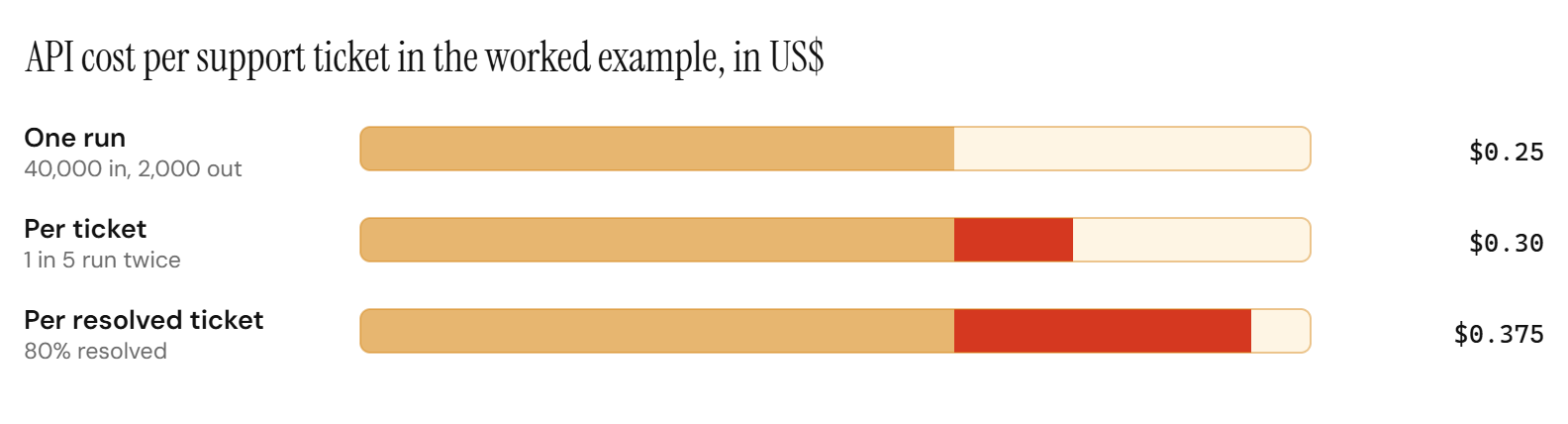
The cost per resolved ticket is 50% higher than the cost of one run, and the whole difference comes from work that was repeated or failed. Quality drives that gap more than price: if the agent resolved 70% of tickets instead of 80%, the cost per resolved ticket would rise to about $0.43 with no change in any token price.
The other 20,000 tickets go to your support team, and their cost comes back in when you compare the AI path with today's process.
How much does an AI agent cost per month?
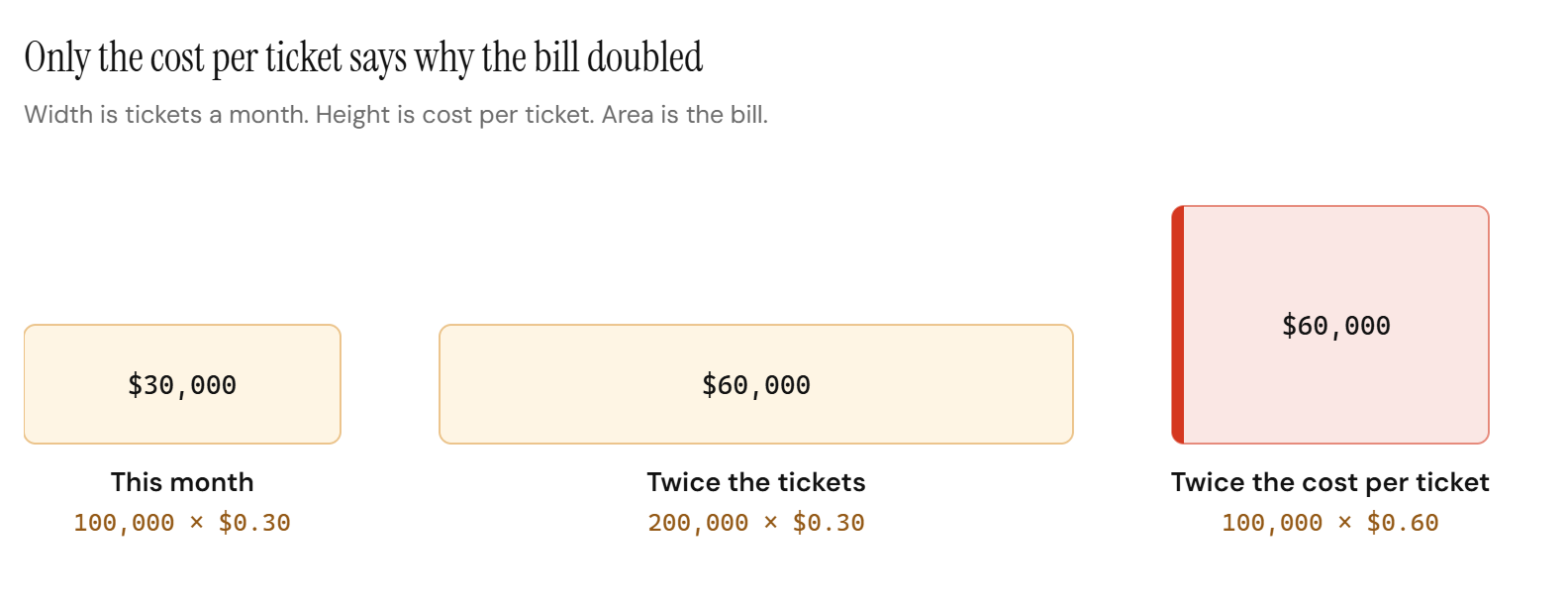
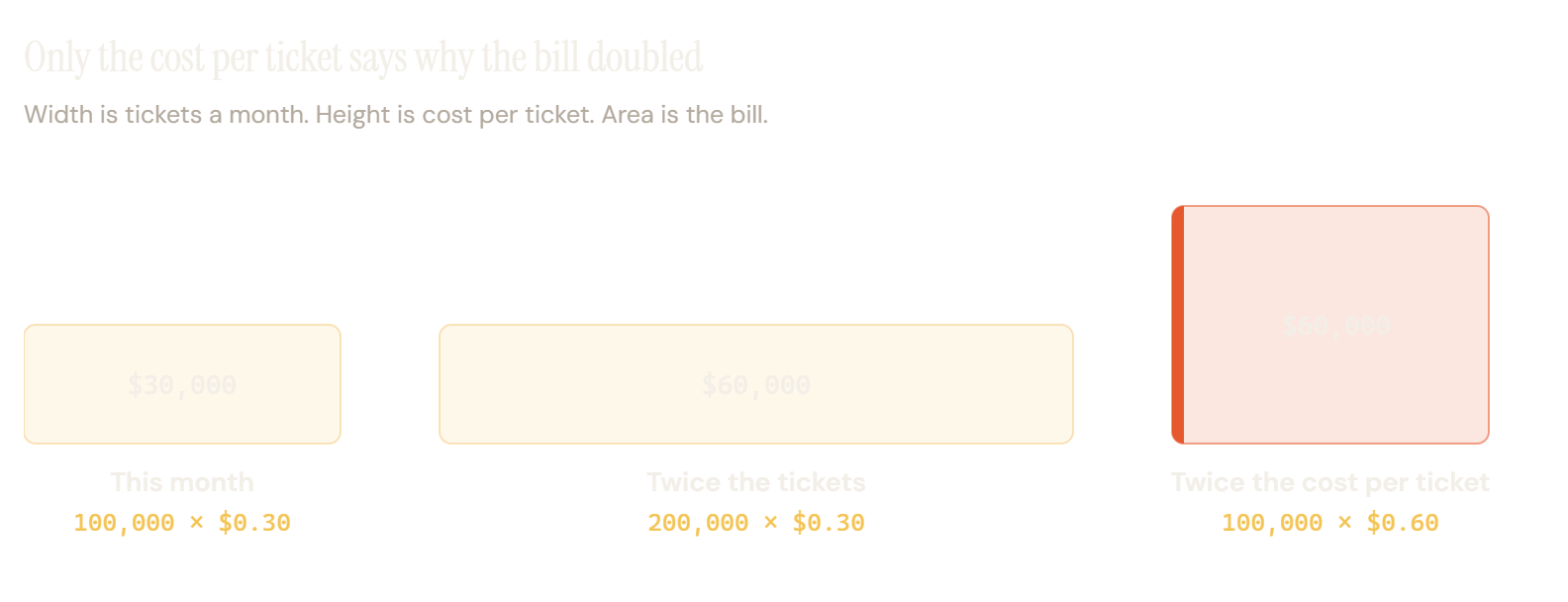
An AI agent costs its monthly task volume multiplied by its cost per task. In the example, 100,000 tickets at $0.30 is $30,000 a month in API calls at October 2026 list prices. The same agent handling 10,000 tickets costs $3,000, and at a million tickets it costs $300,000. Any monthly figure quoted without a volume and a cost per task leaves out the two numbers that decide it.
Splitting the bill into those two numbers also tells you why it changed.
To decide whether the agent pays, set its cost beside what the same ticket costs today. Take your current fully loaded cost per ticket handled by a person, call it H, from your support or operations reporting. The AI path then costs:
AI path, per ticket = AI cost per ticket
                    + share escalated to a person x H
                    + review time per ticket
In the example that is $0.30 + 0.2 × H, plus whatever spot checks you keep on the resolved tickets. The AI path wins when $0.30 plus review time stays below 0.8 × H at the same quality bar. Put your own H in and the decision takes one line, which is the point of measuring per task. Our guide to human-in-the-loop for AI agents covers where those reviews belong.
How do you set a target cost per task?
Give every production task type two numbers: a target that the business plans around and a ceiling that the code enforces.
| Setting | What it is | Who owns it |
|---|---|---|
| Target | Cost per successful task you plan for | Business owner of the task |
| Ceiling | Most one run may spend before it stops | Engineering, enforced in code |
| Review cadence | When actuals are compared with the target | Finance with the task owner |
Set the target from today's cost. Work back from the comparison above. If the AI path has to come in well under the current cost per ticket to justify the change, that margin defines the target. In the example, a target of $0.40 per resolved ticket leaves the agent inside it at $0.375, with little headroom. If one ticket in three needed a second run instead of one in five, the cost per resolved ticket would rise to about $0.42 and break the target.
Set the ceiling from the typical run. A ceiling is a hard stop on steps and tokens per run, so a looping agent cannot spend without limit. With a typical run at $0.25, a ceiling of $1.00 per run leaves room for long tickets and stops runaway ones. A run that hits the ceiling should hand the ticket to a person.
Ceilings for individual runs and allowances for whole teams work together. Our guide to setting an AI token budget for your teams covers the team side, and the enterprise AI budget planning guide shows where these numbers sit in an annual plan.
Why does AI cost per task change from month to month?
Cost per task moves for four reasons, and each one needs a different signal to catch it.
| Source | What moves | What to watch |
|---|---|---|
| Agent step variance | Steps and resent history per run | 95th percentile cost per run |
| Model changes | Price, output length and success rate | Eval scores beside cost per run |
| Prompt changes | Tokens per API call | Cost per run after each release |
| Price changes | List price per token | The date on every price you use |
Step variance is the source most specific to agents. An agent resends its history on every step, so a long run costs disproportionately more. In the example, assume the first API call sends 6,000 tokens of instructions and ticket, each step adds 1,000 tokens of history, and each API call writes 400 tokens. Five steps send 40,000 input tokens, which is the $0.25 run. A twelve-step run sends 138,000 input tokens and writes 4,800, costing $0.81. The run took 2.4 times the steps and cost 3.2 times as much. The engineering fixes for this are in our guide to agentic AI cost optimization.
Model and prompt changes move cost and quality together. Moving the example run to Claude Sonnet 5.5 or GPT-6.1 Sol, both listed at $2 and $10 per million tokens as of October 2026, would cut it from $0.25 to $0.10, and the saving holds only while the success rate holds. A new model version can also write longer answers or resolve fewer tasks, and either one raises cost per successful task even at a lower token price. Rerun the eval and recompute cost per run whenever the model or the prompt changes.
Report the median and a high percentile per task type. An average hides the long tail of expensive runs. Each month, report for every task type:
- Tasks completed and success rate
- Median cost per run, the typical case
- 95th percentile cost per run, the most expensive run in twenty
- Cost per successful task against its target
The median tells you what the work normally costs. The 95th percentile tells you whether the ceiling is set in the right place, and a rise in it is usually the first sign that something changed.
How does owning the model change cost per task?
For a high-volume task, the largest single change to cost per task comes from serving it with a custom model trained for that task. A model trained for one job carries only the capability that job needs, so each task costs less to serve.
The cost per task also becomes more predictable. You decide when the model changes: each new version ships only after it passes your evals, so a provider's model release leaves the unit cost of the traffic the custom model serves unchanged. Volume still drives the bill, and changes to the unit cost happen on a schedule you approve.
This is the work Ertas does with the adaptive model endpoint. An adaptive model endpoint is one API endpoint for one of your tasks: frontier models answer at the start, a custom model trained on your requests and your team's feedback takes over once it passes your evals, and hard cases stay on frontier models.
The drop in cost per task arrives on the day you sign off a version, which makes it easy to see in a monthly report.
Each new version runs in the background on real requests first, and nothing switches without your sign-off. We monitor the model and retrain it as your tasks change. It runs Ertas-managed, in your cloud or on-premise, and you own it. The endpoint is currently invitation only, and we are developing a more streamlined version for wider access.
In the support example, every ticket the custom model resolves to the bar is served at its cost in place of the $0.30 frontier run, and every ticket it hands on keeps the frontier price. For a sense of scale, in our published QMSum study, a model trained for one meeting-summarization task had an estimated serving cost of $0.00053 per query, against $0.104 for Claude Opus 5 and $0.0130 for GPT-5.6 Luna at synchronous list prices, and it answered in 0.39 seconds against 9.0 seconds for Claude Opus 5. The estimate excludes training cost. Every task is different, which is why each switch waits on your evals. For the break-even arithmetic on your own task, see when a custom model beats a frontier API on cost.
Frequently Asked Questions
What is the formula for AI cost per task?
Add up the cost of every API call a task type made in a month, including retries and escalations, and divide by the tasks completed. For cost per successful task, divide by the tasks that met your quality bar instead, and add the human review time the work still needed.
What does an AI agent cost each month?
Monthly cost is tasks per month multiplied by cost per task. In our worked example, a support agent on Claude Opus 5 at October 2026 list prices costs $0.30 per ticket, so 100,000 tickets a month cost $30,000 in API calls. Your figure depends on volume, model, steps per run and how often runs are repeated.
What is the difference between cost per token and cost per task?
Cost per token is the price of model usage, set by the provider. Cost per task is what one piece of work costs you, which depends on how many tokens and API calls the work takes and how often it succeeds. Two models with the same token price can have very different costs per task.
Should human review count in AI cost per task?
Yes, in cost per successful task. Time spent checking outputs, correcting them and finishing handed-over tasks is part of what the AI path costs, and leaving it out makes the AI look cheaper than it is when you compare it with today's process.
Why did our AI cost per task rise when token prices stayed the same?
Usually because each task now takes more tokens or more attempts. Longer agent runs, a prompt change that added context, a model version that writes longer answers, or a drop in success rate all raise cost per task at the same token price. The 95th percentile cost per run and the success rate show which one it was.
Does a custom model make AI costs fixed?
A custom model makes cost per task lower and more predictable on the task it serves, because each new version ships only after it passes your evals. Spend still scales with volume, and the hard cases that go to frontier models keep frontier pricing.
The Short Version
Manage AI spend by cost per successful task: every API call, retry, escalation and review behind one unit of work, divided by the units done to your quality bar. Monthly cost is tasks multiplied by that number. Report the median and 95th percentile per task type, give each task a target and a ceiling, and give your highest-volume task a model of its own to make its cost lower and more predictable.
If you know your cost per task and want it lower, book a call and we will work through it with you.
Sources: FinOps Foundation, Unit Economics, Anthropic pricing, OpenAI API pricing and OpenAI reasoning guide. Prices verified 6 October 2026.