

AI costs are high because companies now use far more tokens for every task and run far more tasks. Requests carry more context and reasoning, agents turn one request into many API calls, use has spread to every team, and most work runs on the newest models, whose prices stay high while older capability gets cheap.
Leaders are feeling it in the budget. At Google I/O in May 2026, Sundar Pichai told the audience that Google had heard many companies were already blowing through their annual token budgets, with the year not yet half over. A month earlier, Axios reported that IT budgets were being blown out as some companies spent more on AI than on salaries.
This guide explains why the bill grows, how to judge whether the spend is paying off, and what leaders can do about it. For the step-by-step playbook on cutting the bill, see how to reduce AI token costs in your company.
Why do AI costs rise when token prices keep falling?
The price of any fixed level of AI capability falls fast. In November 2024, a16z estimated that for a model of equivalent performance, the cost drops about 10x every year: reaching the benchmark score GPT-3 posted in 2021 cost $60 per million tokens then, and $0.06 three years later. Epoch AI found in 2025 that the price of reaching a fixed benchmark score fell between 9x and 900x per year, depending on the benchmark and the score.
Bills rise anyway, because those figures describe the price of standing still. Your AI bill multiplies three numbers:
- The price per token of the models you actually use. Companies keep moving to the newest models, so the capability they buy is rarely the capability getting cheaper.
- Tokens per task. Longer context, reasoning and agent steps make every task bigger.
- The number of tasks. AI has moved out of pilots and into products, workflows and every team's daily tools.
The first number can rise even while capability gets cheaper. In July 2026, J.P. Morgan reported that token prices across the LLM market were up over 60% since December 2025 on a Bloomberg index of the effective price per million tokens, as demand for data-center computing spiked. The other two numbers have grown fastest of all.
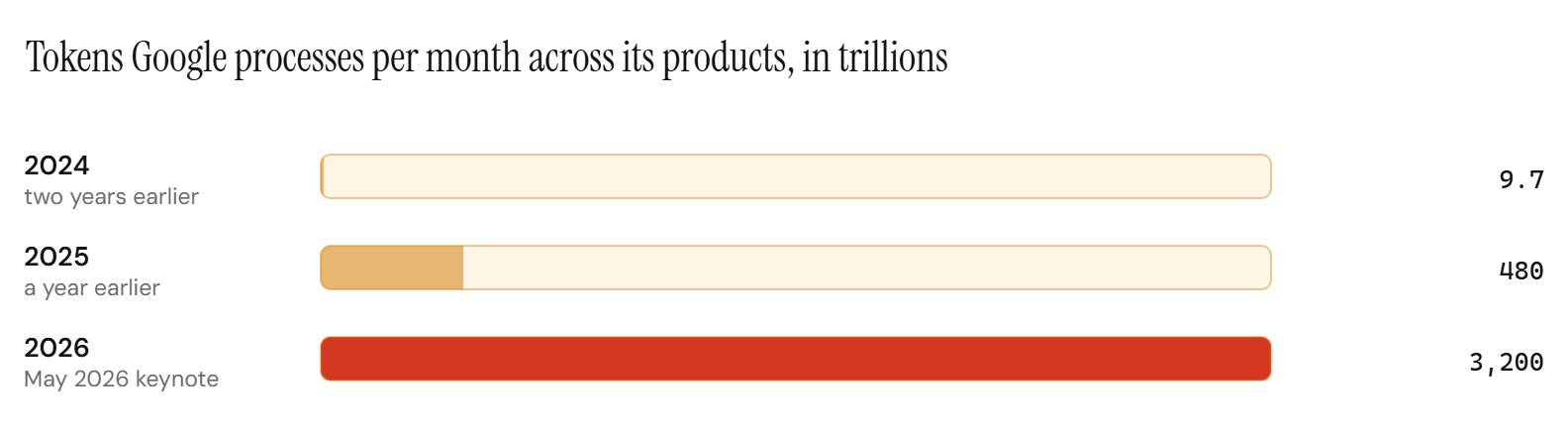
Google's figures span consumer and business products, so they show the direction of demand more than any one company's bill. The same keynote put a business number beside them: over 375 Google Cloud customers had each processed more than a trillion tokens in the previous twelve months.
What is driving AI costs up?
Five forces push the bill up, and most companies are exposed to all of them at once. Each one raises cost without any change on a provider's price list, which is why they are easy to miss in a budget review.
Work runs on the newest, priciest tier
Teams prototype on the strongest model available, ship the feature and rarely revisit the choice. Each upgrade to a newer model keeps the work at a top-tier price, even when a smaller model would now pass the same test for a fraction of the cost.
The spread is wide. As of October 2026, Anthropic lists Claude Opus 5 output at $25 per million tokens and Claude Haiku 4.5 at $5, and OpenAI lists GPT-6 Astra output at $50 and GPT-6 Luna at $0.50. The capability whose price collapses is last year's frontier, and most teams are buying this year's.
Each request carries more context
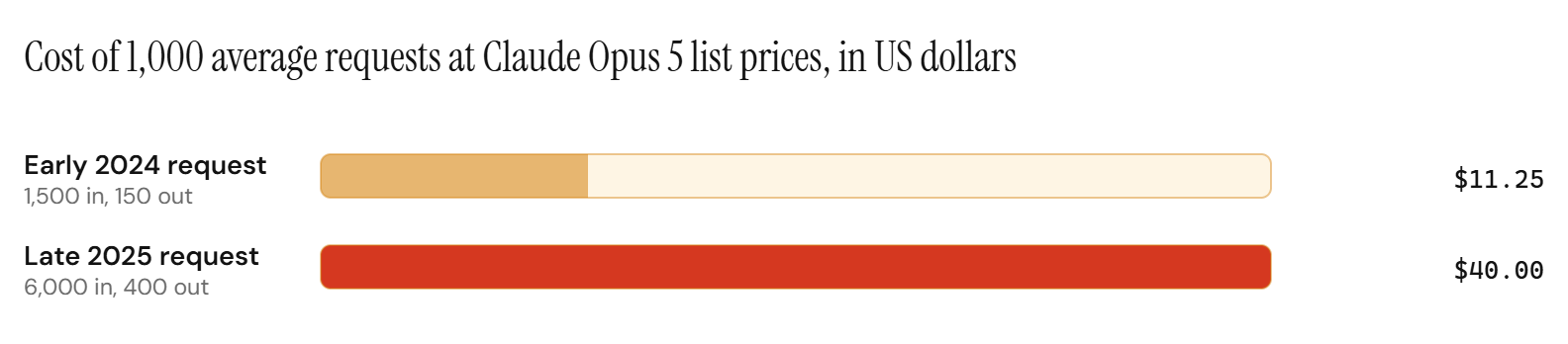
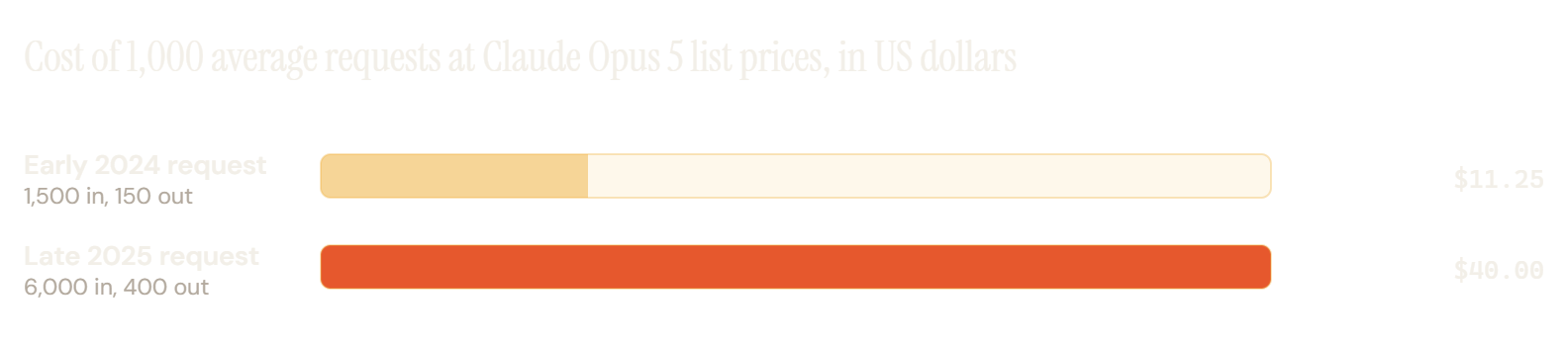
Applications now send whole documents, code, conversation histories and retrieved files with every request. A study by OpenRouter and a16z of over 100 trillion tokens found that average prompt length grew roughly fourfold, from around 1,500 tokens per request in early 2024 to over 6,000 by late 2025. Output nearly tripled over the same period, from about 150 tokens to 400.
Nothing in the price list flags this growth. As of October 2026, Anthropic bills its full 1M-token context window at standard per-token rates, so a request forty times longer simply costs forty times as much.
Models think before they answer
Reasoning models work through a problem before they reply, and the thinking is billed. OpenAI's documentation states that reasoning tokens are billed as output tokens, and output is the expensive side of the bill: as of October 2026, Claude Opus 5 lists output at five times its input price.
The shift happened quickly. The same OpenRouter study found that reasoning models handled a negligible share of tokens on the platform in early 2025 and more than half by the end of that year, and it attributes most of the growth in output length to reasoning.
Agents turn one request into many API calls
An agent handling a single request plans, searches, uses tools and checks its own work. Every step is its own API call carrying everything that came before, so the cost of a request depends on how many steps the agent takes. That number varies from run to run and is set by how the agent behaves more than by what the user asked.
Agents also run without anyone typing. A support agent or a coding agent can make thousands of API calls an hour across a team. Our guide to agentic AI cost optimization covers how engineers keep each run bounded.
AI has spread from pilots to every team
Two years ago, the open question was whether businesses would use AI at all, as J.P. Morgan put it in July 2026. Today it sits in support queues, sales tools, document workflows and engineers' editors, and each new use adds its own line to the bill.
Pricing has followed usage. J.P. Morgan noted that providers have been moving enterprise plans from per-seat charges to pricing that scales with activity, so for many companies AI now bills like a utility. Spend that used to be capped by the number of licenses now grows with every task.
Does AI cost more than employees?
For some teams it already does. Fortune reported that Bryan Catanzaro, vice president of applied deep learning at Nvidia, told Axios in April 2026: "For my team, the cost of compute is far beyond the costs of the employees."
The comparison makes a headline, and it answers a narrow question. A research group that builds models will always spend heavily on compute. For an operating business, AI spend per employee measures the size of the bill. A leader needs to know what each unit of that spend produces.
The useful comparison works per task: what a resolved ticket, a reviewed contract or a drafted report costs with AI, against what it cost before and what it is worth to the business. Our guide to AI cost per task walks through how to set that number up and track it.
How can leaders tell whether AI spend is worth it?
Price the work task by task. The tokens a task consumes vary enormously by the type of work, so a single company-wide average hides where the money goes.
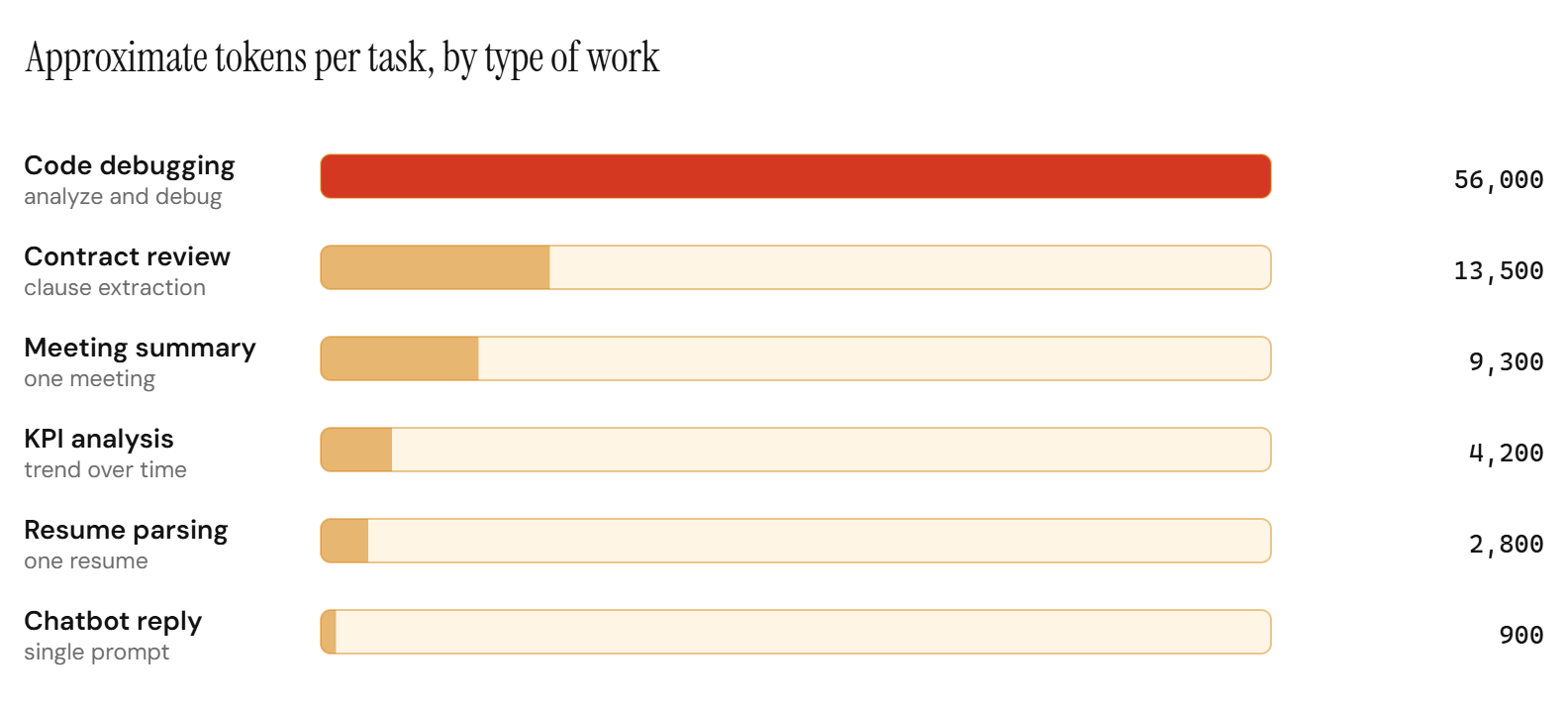
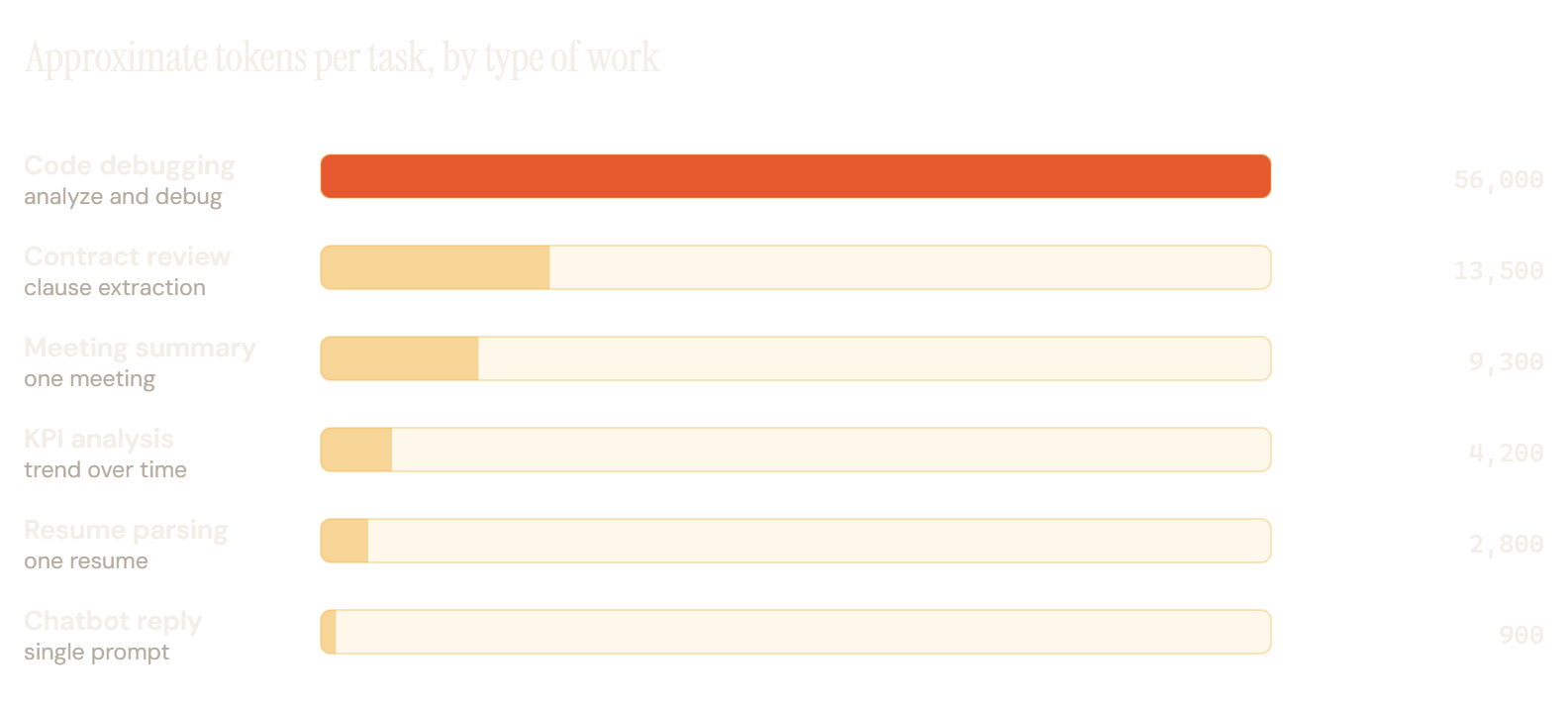
For each major task type, three numbers settle whether the spend is earning its keep.
| Number | What it tells you |
|---|---|
| Cost per completed task | What one unit of AI work costs |
| Value per completed task | Time saved, revenue gained or risk avoided |
| Completed tasks per month | How much the gap matters in total |
A task whose value per completion sits well above its cost is worth scaling, and its cost is worth managing as it scales. A task with a thin or unknown margin needs a cheaper way to run, or a clearer measure of value, before it grows. Most bills that surprise a finance team grew in exactly that gap: volume rose on tasks whose cost per completion nobody had measured.
What can leaders do about rising AI costs?
Each driver above has a matching move, and all of them leave the useful work running.
| Driver | Leader's move | Where to start |
|---|---|---|
| Spend nobody can explain | Track cost per task for top workloads | Cost per task |
| Use spreading across teams | Set team token budgets and default tiers | AI token budgets |
| Top tier by default | Test cheaper tiers against an eval | Reduce token costs |
| Context and reasoning | Cache, trim context, cap reasoning | 12 techniques ranked |
| Agent steps | Cap steps and tokens per run | Agentic AI costs |
| One task at huge volume | Give it a custom model | See the next section |
Most of these are configuration and policy changes a team can make within a quarter. The last one changes the price of the work itself, which matters most when a single task carries a large share of the bill.
When does a custom model change the cost curve?
When one task runs thousands of times a day on a frontier model, every repetition pays the frontier price, and most of those requests are routine. A custom model trained for that one task can handle the routine share at a much lower cost per task, while frontier models keep the hard cases. Cost per task falls on your largest workload, and it becomes more predictable, because the routine share is served by a model you own.
This is what Ertas builds with the adaptive model endpoint: one API endpoint for one of your tasks. Frontier models answer every request at the start. A custom model trained on your requests and your team's feedback runs in the background on real traffic, and takes over once it passes your evals and you sign off. Hard cases stay on frontier models. The endpoint is currently invitation only, and we are developing a more streamlined version for wider access.
As volume grows, the extra traffic lands on the custom model, so frontier spend grows with the hard cases alone.
Your engineers point the task at the endpoint by changing one model name. We monitor the model and retrain it as your work changes, and each new version passes the same evals before it serves traffic. It runs Ertas-managed, in your cloud or on-premise, and you own it.
The savings come from serving a model built for one job. In our QMSum study, a model trained for one meeting-summarization task had an estimated serving cost of $0.00053 per query, against $0.104 for Claude Opus 5 and $0.0130 for GPT-5.6 Luna at synchronous list prices, and it answered in 0.39 seconds against 9.0 seconds for Claude Opus 5. That estimate excludes training cost. Each task has its own quality bar, which is why every switch waits on your evals.
Frequently Asked Questions
Why are AI costs so high in 2026?
Companies use far more tokens than they did a year ago. Requests carry more context, reasoning models bill their thinking as output, agents make many API calls per request, and AI has spread across teams and products. Much of that work runs on top-tier models, which list output at $25 to $50 per million tokens as of October 2026.
Are AI token prices going up or down?
Both, depending on what you measure. The price of a fixed level of capability has fallen 10x or more per year, according to a16z and Epoch AI. The effective price the market pays per token rose over 60% between December 2025 and July 2026 on a Bloomberg index cited by J.P. Morgan, as demand for computing power spiked.
Does AI really cost more than human workers?
For some teams, yes. An Nvidia research leader told Axios in April 2026 that his team's compute costs far exceed its employee costs. For most companies the more useful test is per task: what a completed task costs with AI, against what it cost before and what it is worth.
Why did our AI bill grow when we did not add users?
Usage per request and per person grew. Longer prompts, reasoning, agent steps and model upgrades all raise the tokens behind each task, and none of them appear as a new seat. Ask your engineering team for tokens per task by workload over the last six months to see which one moved.
Will AI costs come down on their own?
If the trends a16z and Epoch AI measured continue, the price of any given capability will keep falling. Bills come down where someone moves work to cheaper capability: a smaller tier, a cached prefix, a batch job or a custom model. Left alone, falling prices tend to be absorbed by new usage.
How does a custom model lower AI costs?
A model trained for one task carries only what that task needs, so it costs far less per request to serve. With an adaptive model endpoint, it takes over the routine share of one high-volume task once it passes your evals, and hard cases keep going to frontier models.
The Short Version
AI bills rise while token prices fall because companies buy the newest capability, put more tokens into every task and run more tasks every month. Measure cost per task, set budgets and default tiers, take the configuration savings, then give your highest-volume task a model trained for it.
If one task already carries most of your bill, book a call and we will work through the numbers with you.
Sources: a16z on LLMflation, Epoch AI on inference price trends, J.P. Morgan (including Wolfe Research task figures), OpenRouter and a16z State of AI study, Google I/O 2026 keynote, Fortune, Axios, Anthropic pricing and OpenAI reasoning guide. Prices verified 6 October 2026.